Osuitok Ipeelee
1923 - 2005 RCA
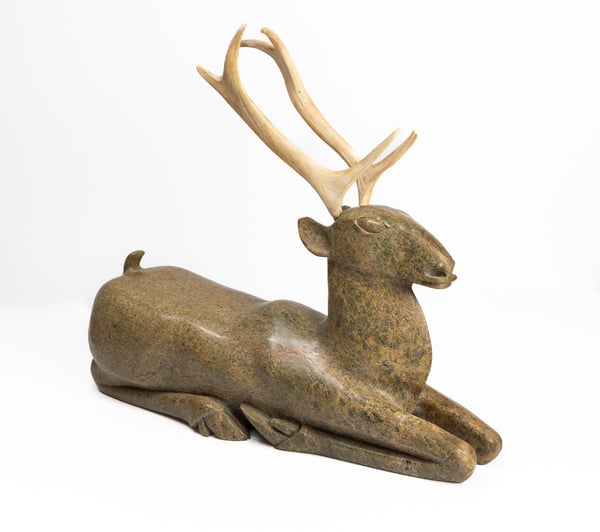
Osuitok Ipeelee Biography
1923 - 2005 RCA
Osuitok Ipeelee was a master carver and a foundational figure in the development of contemporary Inuit art in Kinngait (Cape Dorset). Born in 1923 in the Neeouleeutalik camp, he learned to carve from his father, Ohotok Ipeelee. During his youth, he developed his skills by creating ivory miniatures of hunting equipment and small figures, which he traded with local missionaries and traders. His early practice was rooted in traditional Inuit survival skills and material culture, establishing a deep technical foundation that would later define his mastery of stone.
In the 1950s, Ipeelee became a central figure in the nascent art movement in Kinngait. He was a key collaborator with James Houston, helping to establish the West Baffin Eskimo Co-operative and assisting in the development of local printmaking and sculpture programs. During this period, he was credited as Oshaweetok B in early institutional catalogues. His work gained national recognition quickly, appearing in significant exhibitions such as the 1952 and 1955 Eskimo Art exhibitions held at the National Gallery of Canada.
Throughout his long career, Ipeelee received numerous prestigious commissions that underscored his status as a premier sculptor. In 1955, he directed a team of craftsmen in the creation of an official mace for the Council of the Northwest Territories. In 1959, he was commissioned to carve a sculpture of Queen Elizabeth II to be presented to the monarch during her visit to Canada. He continued to create works of exceptional balance and precision, often depicting Arctic wildlife such as caribou and birds, as well as mythological subjects.
Ipeelee was recognized widely for his contributions to the arts. He was elected a member of the Royal Canadian Academy of Arts (RCA) in 1973, marking a significant milestone for Inuit artists in Canadian institutions. In 2004, he received the Lifetime Aboriginal Art Achievement Award, now known as the Indspire Award. Ipeelee passed away in 2005 in Cape Dorset. His work remains an essential part of the permanent collections of major public institutions, including the National Gallery of Canada, the Winnipeg Art Gallery, and the Art Gallery of Ontario.