William Epp
1930 - 1995
William Epp Biography
1930 - 1995
William Harold Epp was a Canadian sculptor and educator recognized for his figurative works and his contributions to the artistic landscape of Saskatchewan. Born on June 12, 1930, in Glenbush, Saskatchewan, Epp grew up on a farm where he developed an early interest in the creative manipulation of materials. His father was a blacksmith, and exposure to metalwork and industrial machinery during his youth significantly influenced his later technical approach to sculpture.
Epp began his formal arts training in 1948 at the Saskatoon Teachers' College, where he studied under Wynona Mulcaster. He continued his education at the Banff School of Fine Arts and the Winnipeg School of Art, where he studied with Cecil Richards. His artistic development was further shaped by a 1955 workshop at Emma Lake under the mentorship of Jack Shadbolt. In 1968, he earned a Bachelor of Arts from the University of Saskatchewan, where he studied with Eli Bornstein.
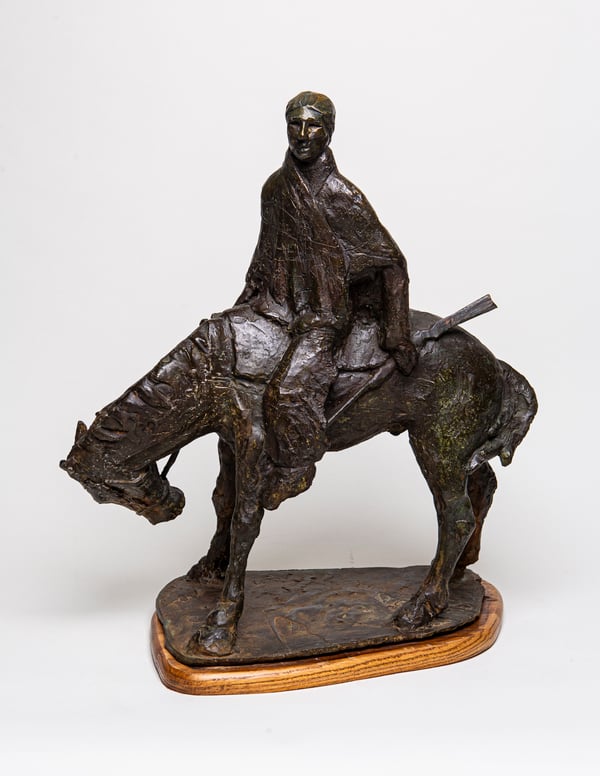
Following his initial training, Epp spent nearly two decades teaching in elementary and high schools across Saskatchewan. In 1967, he joined the Department of Art at the University of Saskatchewan. During his long tenure there, he taught sculpture, drawing, design, and art history until his retirement in 1993. Throughout his career, he explored diverse media, including welded steel, wood, clay, fiberglass, stone, and bronze. To support his practice in bronze casting, he constructed his own foundry on his farm near Martensville, Saskatchewan.
Epp was a central figure in the provincial arts community and a founding member of the Prairie Sculptors' Association in 1982. His portfolio includes numerous public commissions that remain visible in civic spaces. Notable public works include the "Spirit of Youth" monument created for the 1989 Canada Summer Games in Saskatoon, a commemorative statue of Sir Wilfrid Laurier and John Diefenbaker, and a bronze monument of Lieutenant Harry Colebourn and Winnie the Bear, installed at the Assiniboine Park Zoo in Winnipeg.
His work is preserved in the permanent collections of major public institutions, including the Saskatchewan Arts Board, the University of Saskatchewan, and the Remai Modern. William Epp continued to produce art and influence students until his death on September 4, 1995.