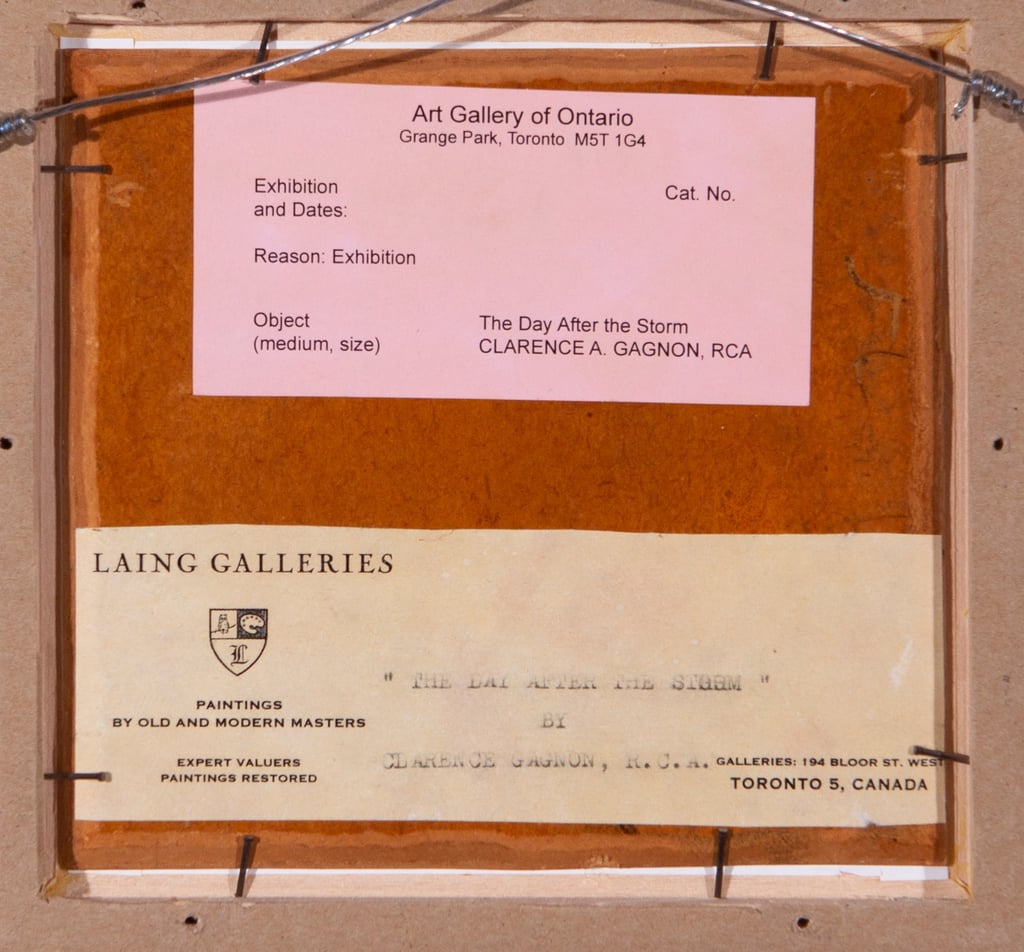
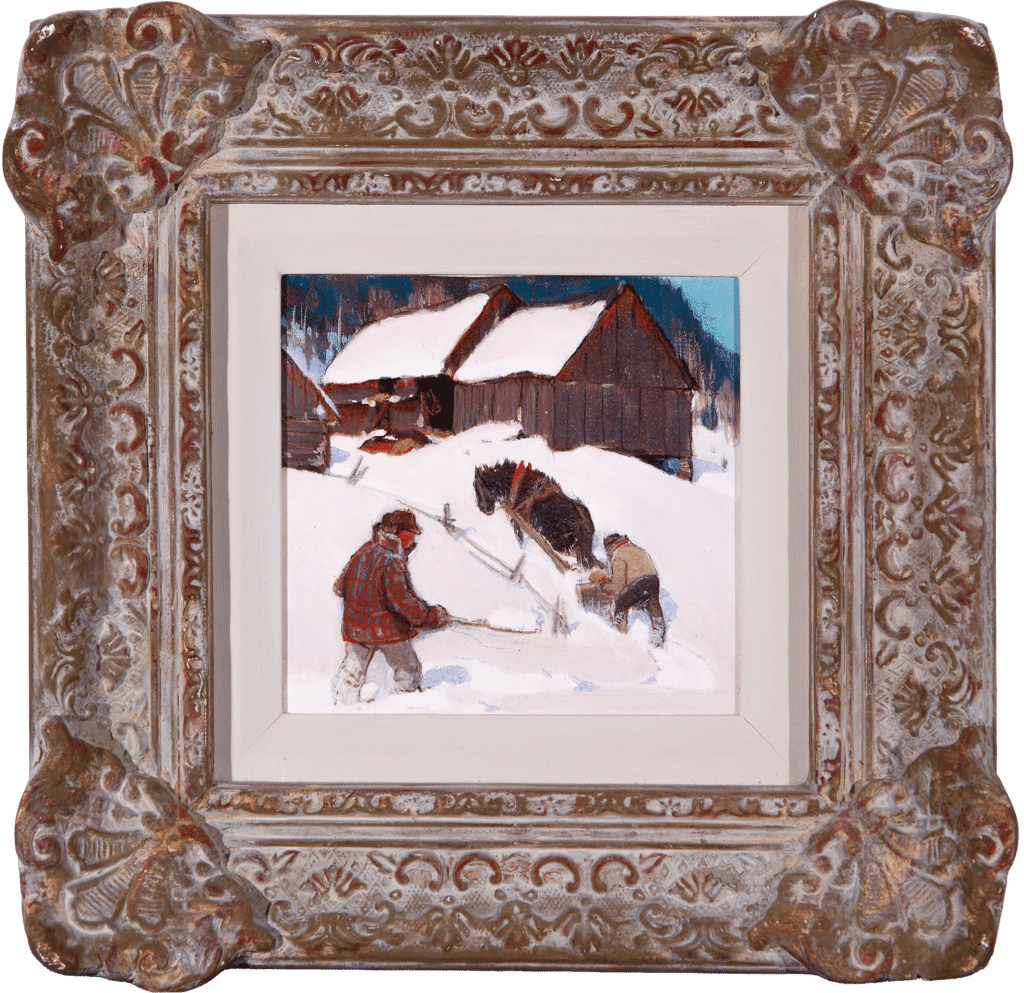
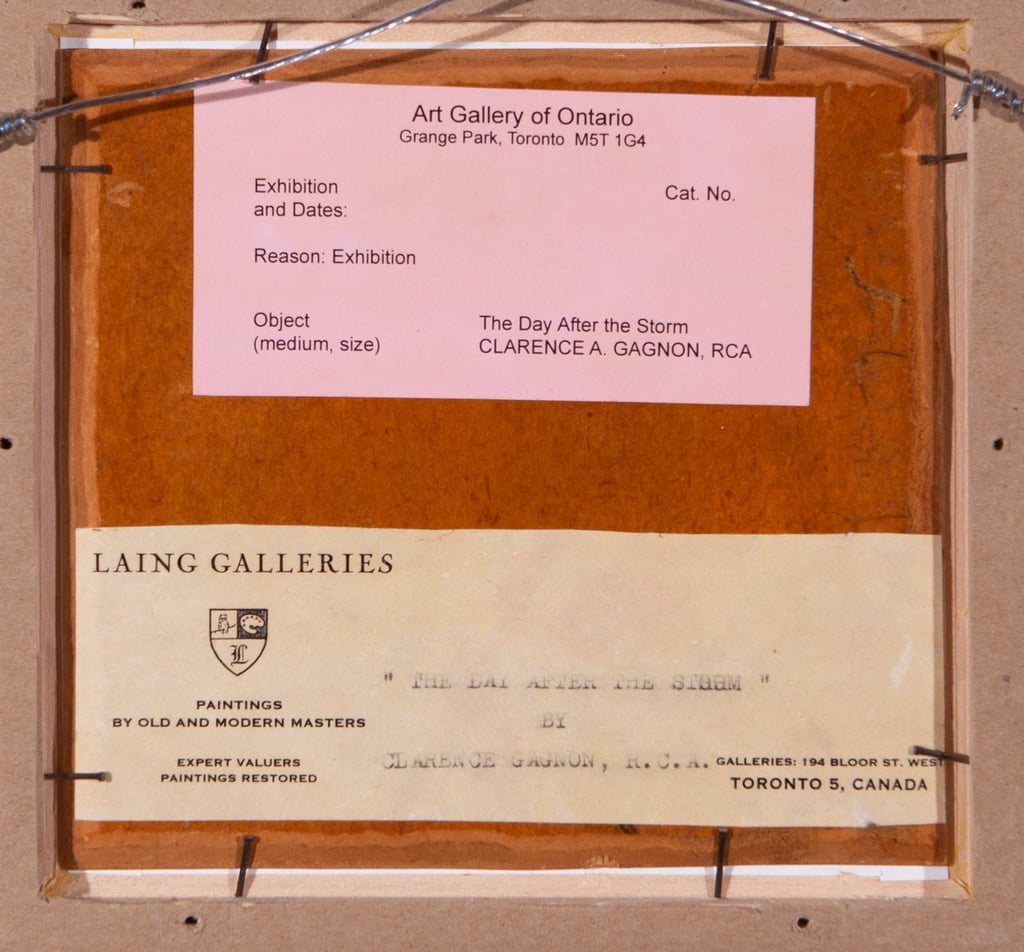
The Day After the Storm
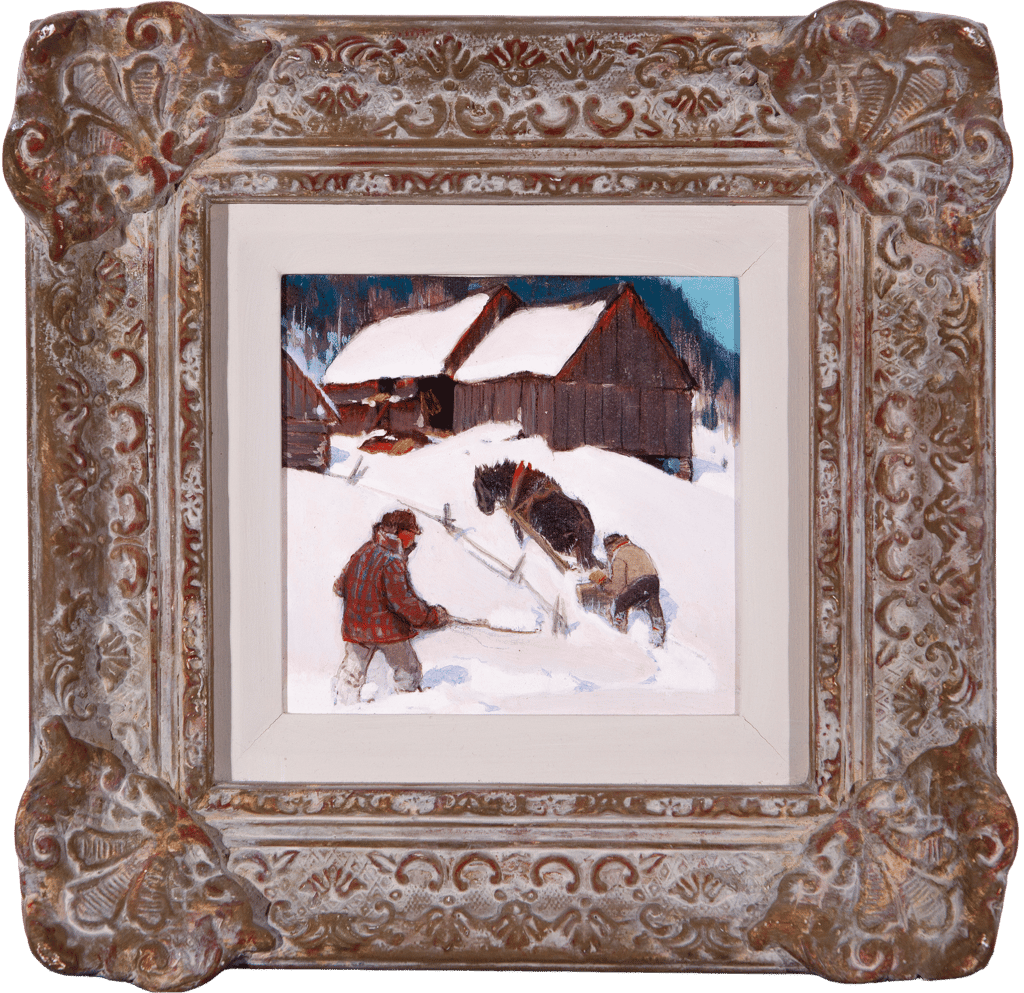
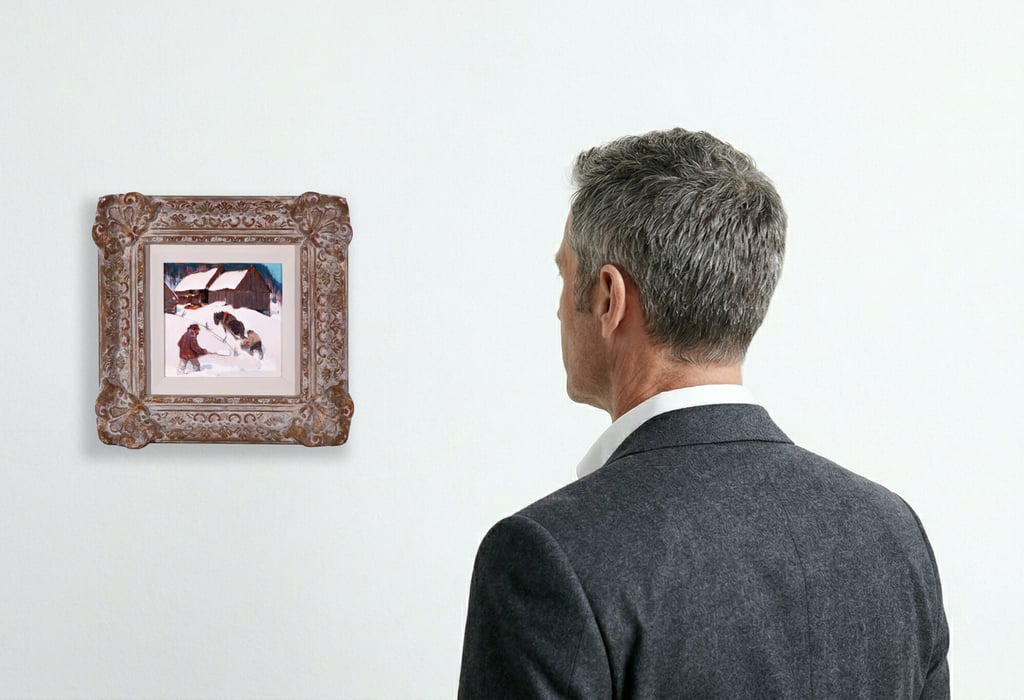
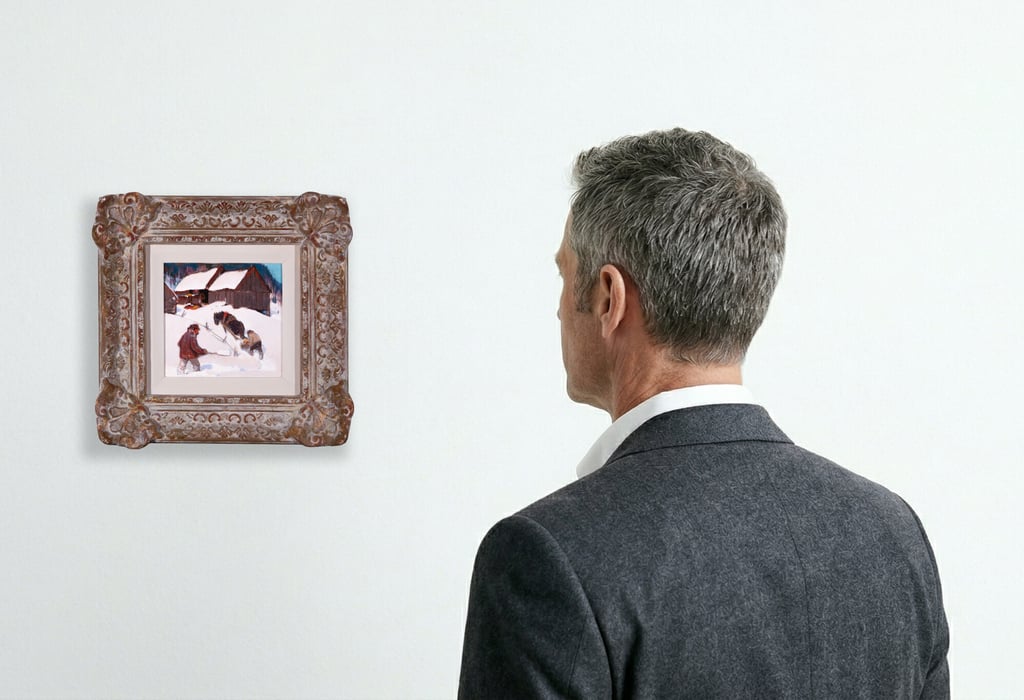
10.5 x 10.75 in (26.7 x 27.3 cm) including frame
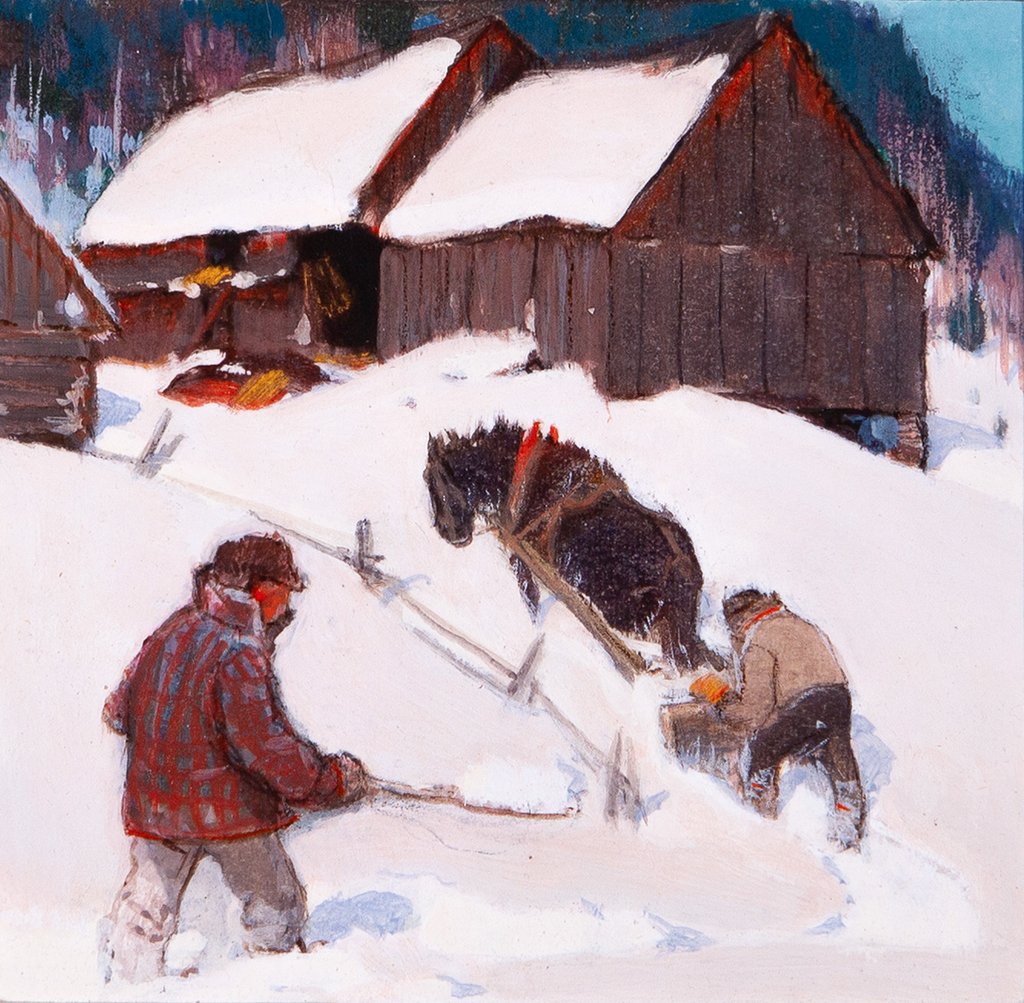
Clarence Gagnon is widely regarded as the definitive painter of rural Quebec, famous for his vibrant and nostalgic depictions of life in the Charlevoix region. This small-scale work, The Day After the Storm (circa 1930), is directly related to his most celebrated project: the illustrations for the 1933 edition of Louis Hémon’s novel Maria Chapdelaine. To create the 54 paintings for this series, Gagnon spent years refining a specialized mixed-media technique, often using egg tempera and oils, to achieve a luminous, jewel-like quality.
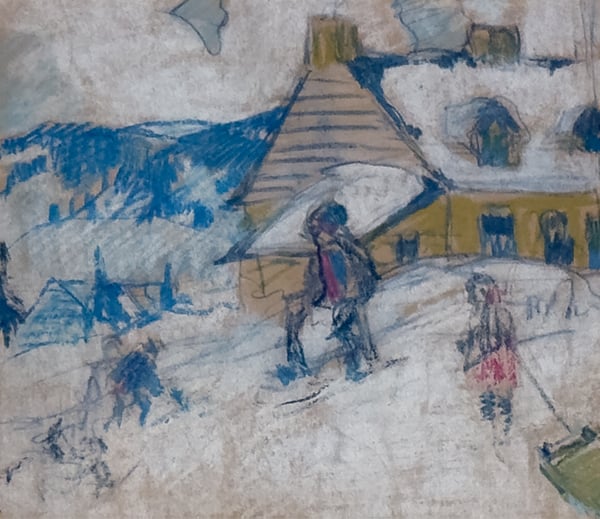
The painting depicts the essential labor required to clear paths and tend to livestock following a heavy snowfall. The composition features two figures and a horse working against deep drifts, set against the backdrop of weathered barns typical of the St. Lawrence Valley. Like the other works in the Maria Chapdelaine series, this piece emphasizes the resilience of the local inhabitants and the architectural harmony of the traditional French-Canadian farm. Despite its small size, the work captures the intense clarity of winter light and the specific textures of the Quebec landscape, serving as a significant example of Gagnon’s role in documenting the province's cultural heritage.
Clarence Gagnon
1881 - 1942 RCA
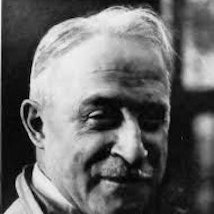
Clarence Alphonse Gagnon was born on November 8, 1881, in Montreal, Quebec, the son of Alphonse-Edmond Gagnon, a merchant and milling manager, and Sarah Ann Willford, a cultured English mother interested in literature. Part of his childhood was spent in Sainte-Rose, a village north of Montreal, where his family enjoyed a comfortable lifestyle. His artistic talent emerged early when he won his first art competition at age eight. Despite his father's desire for him to pursue business, his mother encouraged his interest in drawing and painting. After completing his studies at the Académie du Plateau in Montreal in 1898, where he was honored with awards for excellence and English language achievement, Gagnon refused his father's business plans and enrolled in free evening classes at the Council of Arts and Manufactures.
In 1897, Gagnon began studying with William Brymner at the Art Association of Montreal, where he remained until 1903. Brymner provided rigorous instruction based on studying plaster casts, live subjects, copying masters' works, and painting outdoors, while encouraging students to explore individual vision and formal innovations. During his studies, Gagnon was exposed to Japanese art and had a decisive encounter with painter Horatio Walker, whose Barbizon School-influenced depictions of rural landscapes impressed him greatly. His early paintings of rural themes attracted the attention of art lover and dealer James Morgan, who signed a contract with Gagnon in December 1903 to finance his first trip to France. For "Ploughing with Oxen" (1903), one of the paintings entrusted to Morgan, Gagnon won a bronze medal at the Louisiana Purchase Exposition in St. Louis in 1904.
Gagnon arrived in Paris in January 1904 and enrolled at the Académie Julian, studying under Jean-Paul Laurens until April 1905. He established himself in the Montparnasse quarter alongside other Montreal artists and traveled extensively throughout Spain, Morocco, Brittany, Normandy, Rome, and Venice. During this period, he also distinguished himself as an engraver, joining the American Art Association of Paris in 1904 and learning etching with Donald Shaw MacLaughlan. His participation in exhibitions at the Salon de la Société des Artistes Français and the American Art Association of Paris in 1906 drew significant attention, with influential critic Roger Marx praising him as "the most gifted and most profoundly artistic" among new etching practitioners. His success in printmaking led to participation in some thirty exhibitions across Europe and North America.
After returning to Canada in 1907, Gagnon settled in the Baie-Saint-Paul region of Charlevoix, which became central to his artistic identity. His career reached a turning point in 1913 with his solo exhibition at the Galerie A.M. Reitlinger in Paris, titled "Paysages d'hiver dans les montagnes des Laurentides au Canada," which featured seventy-five paintings and studies, mostly winter scenes from Quebec. This exhibition, the first major solo show for a living Canadian artist in Paris, established his reputation as a painter with his own interpretation of the Canadian winter and habitant life. From 1919 to 1924, living in Baie-Saint-Paul, he produced some of his most celebrated work, often joined by fellow artists A.Y. Jackson, Albert Henry Robinson, Edwin Holgate, Mabel May, and Lilias Torrance on sketching trips throughout the region.
Gagnon's artistic philosophy centered on preserving and celebrating traditional rural life threatened by industrialization. He became deeply involved in the arts and crafts movement, partnering with rural artisans in Charlevoix to design cartoons for hooked rugs and patterns for ceintures fléchées (arrow sashes), distributing their products through the Canadian Handicrafts Guild. He also developed his own pigments and colors, efforts that culminated in receiving the William Trevor Prize of New York's Salmagundi Club in 1923 for "Winter Morning, Quebec" (1922). His commitment to craftsmanship extended to his illustration work, particularly the fifty-four illustrations for Louis Hémon's "Maria Chapdelaine" (1933), which took five years to complete and achieved immediate success in France and Canada.
Gagnon returned permanently to Canada in 1936, settling in Montreal while retaining his Paris studio. During his final years, he advocated for the preservation of French-Canadian heritage and the revival of domestic and rural arts, interests he shared with ethnologist Marius Barbeau. He became involved in creating folklore museums for Île d'Orléans and Mount Royal, though these projects never materialized. An uneasy witness to the rise of contemporary art movements, Gagnon delivered a virulent speech against modernist art at the Pen and Pencil Club titled "The Grand Bluff of Modernist Art." He was elected to the Royal Canadian Academy of Arts in 1922 and received an honorary doctorate from the Université de Montréal in 1938. Gagnon died on January 5, 1942, at the Royal Victoria Hospital in Montreal at age sixty, weakened by pancreatic cancer. His work is held in major collections including the National Gallery of Canada, the Art Gallery of Ontario, the McMichael Canadian Art Collection, and internationally at the Victoria and Albert Museum in London and the Petit Palais in Paris.
More work by Clarence Gagnon